

A Home Where the Bison Roam
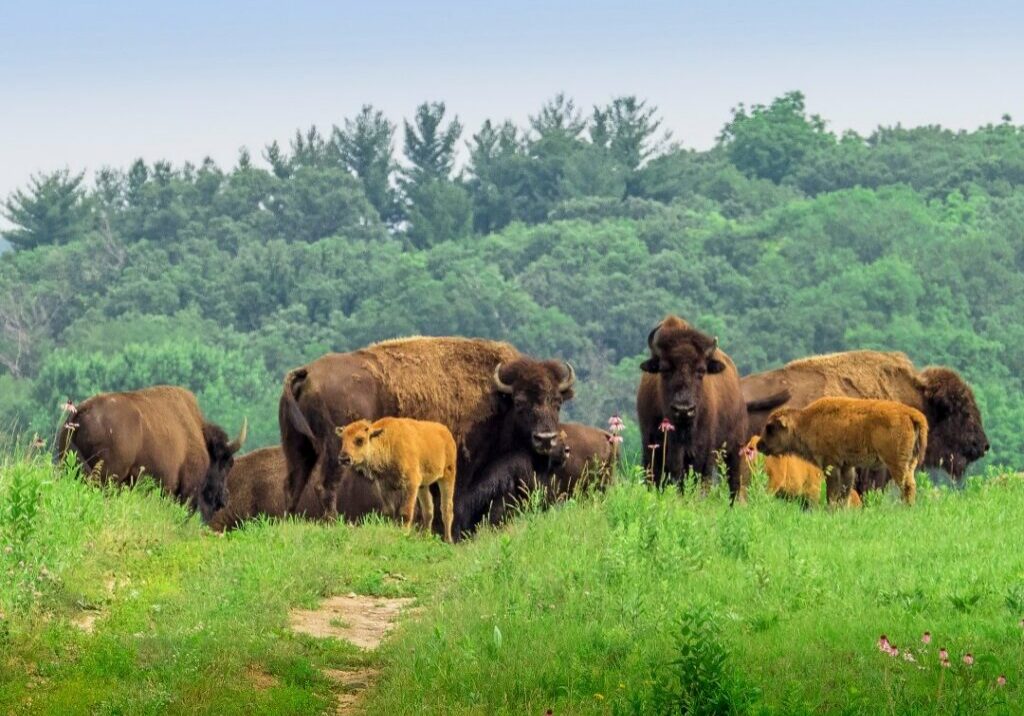
Photo by Charles Larry
Illinois’ prairie at Nachusa Grasslands has been restored over the past 40 years thanks to The Nature Conservancy
There are few places left in the Midwest where you can hear the uninterrupted breeze moving through waist-high grasses and spot a herd of American bison grazing as they did centuries ago. Yet less than an hour-and-a-half drive west of Chicago’s western suburbs, nature lovers, bird watchers, photographers, hikers, families looking for an outdoor adventure, or anyone simply craving a break from the busyness of the burbs can find just that at Nachusa Grasslands, one of Illinois’ most unexpected treasures.
Precious Prairie
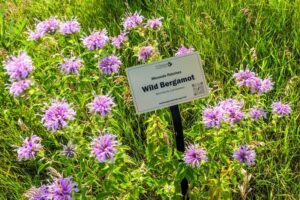
Visitors learn about vegetation native to Illinois prairie lands through signage along the trails at Nachusa Grasslands.
Photo by Carolina Menapace
Located in Franklin Grove and managed by The Nature Conservancy, a global environmental nonprofit, Nachusa Grasslands boasts 4,000 acres of one of the largest and most biologically diverse prairie ecosystems in the region.
“Nachusa Grasslands, one of the Midwest’s prairie restoration success stories, shows what’s possible when science, long-term stewardship and community support come together,” said Bill Kleiman, The Nature Conservancy’s Nachusa Grasslands director.
Operational since 1986, the preserve has steadily expanded and restored the land toward its authentic prairie state. “What was once fragmented habitat among farm fields before The Nature Conservancy acquired the first 400 acres four decades ago is now home to thousands of native plant, bird, and bee species, as well as a herd of more than 100 bison,” Kleiman explained.
Bison Spotting
Bison were brought to Nachusa Grasslands in 2014. Visitors may view the bison at designated lookout points along the road adjacent to the Grasslands. The magnificent mammals may also be observed from Nachusa Grasslands’ five designated hiking trails, each featuring 60-350 acres to traverse and explore.
“To watch the land come back and express itself through this amazing vegetation…is extremely satisfying.”
– Bernie Buchholz, longtime Nachusa Grasslands volunteer
Nothing but Nature
Visiting Nachusa Grasslands is a multisensory experience – the landscape bursting with color and the air alive with birdsong and other insect and animal vocalizations. Besides bison, the property is home to approximately 250 different bird species. One of the preserve’s functions is to protect rare and threatened species, such as the bobolink, a migratory songbird, and the ornate box turtle. Over 700 native plants are also thriving at Nachusa Grasslands, many identified with signage along the trails.
Take a Tour
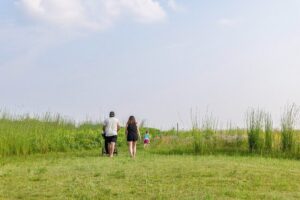
A visit to Nachusa Grasslands is fun for the whole family.
Photo by Carolina Menapace
Visitors to Nachusa Grasslands may explore on their own or, with advance registration, take a prairie and bison tour offered by Friends of Nachusa Grasslands, a nonprofit founded by volunteers dedicated to helping provide for the long-term care and management of the preserve. Visitors are encouraged to wear long pants, sturdy shoes, and a hat and bring water, insect repellent, and sunscreen. Binoculars may also optimize the experience. Pets are not permitted on the property.
Make a Mark
Consider not only visiting but volunteering! At last count, the annual volunteer hours at Nachusa Grasslands totaled 8,400. Volunteers collect native prairie seed, remove invasive plants, assist with prescribed fire management, help lead educational programs, and more. Volunteer opportunities range from single-day workdays to regular shifts.
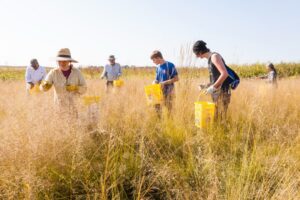
During a workday at Nachusa Grasslands, volunteers pick prairie drop seed from
a large propagation garden.
Photo by Dee Hudson
Bernie Buchholz, a longtime volunteer and founder of Friends of Nachusa Grasslands, became “smitten” after participating in a workday over 20 years ago. Since then, the finance professional turned “self-taught field ecologist” from Oak Park travels to Nachusa regularly from March to December to help with fieldwork, often staying in volunteer housing during his typical three-day visits.
What keeps Buchholz and other volunteers coming back? For some, it’s therapeutic, Buchholz explained. Also, “to watch the land come back and express itself through this amazing vegetation…is extremely satisfying,” he said. “It’s also the community; volunteers at Nachusa are extremely well supported by staff or other volunteers.”
To learn more about volunteering at, visiting, or donating to The Nature Conservancy’s Nachusa Grasslands, visit nachusagrasslands.org.
Bison Basics
Bison have many habits that help sustain the prairie. For example, their patchy grazing makes room for a higher diversity of plants leading to a healthier prairie. Here are some other fun facts about the mighty bison.
It’s the largest land mammal in North America, with the males weighing up to 2,000 pounds.
Bison can run up to 35 mph, and their typical lifespan is 15-20 years.
Bison’s fur is so thick that snow on it doesn’t melt.
People often refer to bison and buffalo interchangeably, but they’re two distinct animals. To spot the differences, note that bison are bearded but buffalo are beardless. Also, consider these 3 H’s:
- Humps: Bison have one at their shoulders for their heads to function like snowplows in the winter, while buffalo do not have humps.
- Horns: Bison have short, sharp horns, while buffalo have longer, arced horns measuring up to over six feet.
- Homes: Bison are native to North America and Europe. Buffalo are indigenous to Africa and Asia.