
Home Court Advantage
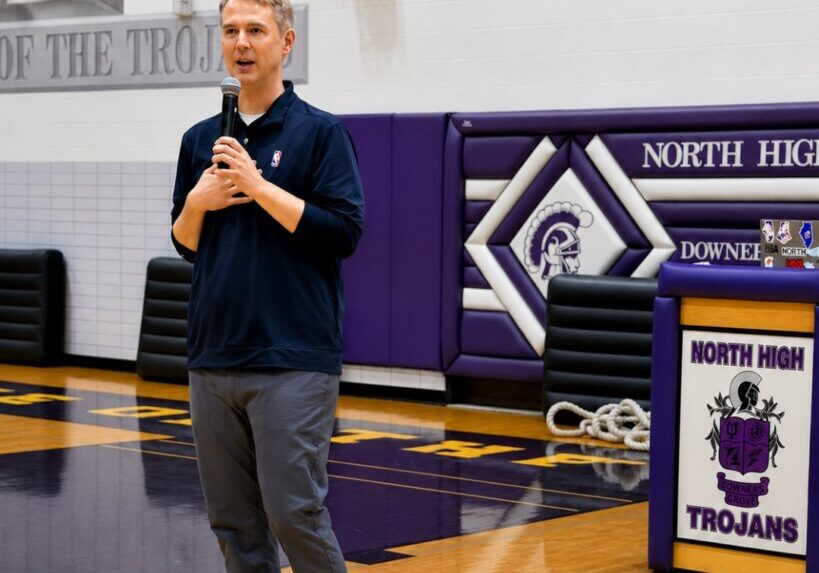
DGN alum Charlie Rohlf connects passions for sports, technology, and statistics into a career with the NBA

DGN Class of 2001
Downers Grove native Charlie Rohlf leads one of the National Basketball Association’s most important teams.
He’s not a coach, scout or general manager. Instead, as the NBA’s Vice President of Stats Technology Product Development, Rohlf oversees the software engineers and data scientists responsible for transforming the league’s vast collection of basketball data into insights for teams, broadcasters, and millions of fans of the NBA, WNBA, and its affiliate leagues.
“My team is responsible for taking a whole lot of data and turning it into insights that are meaningful for our various stakeholders,” Rohlf explains.
It’s a dream job that began with a foundation built growing up in Downers Grove.
“Thanks to my two incredible parents, my whole childhood was spent in Downers Grove,” he says. “I went to Avery Coonley through eighth grade. I played youth sports. I volunteered at Good Samaritan Hospital. I coached Park District T-ball. It all provided a great foundation for me.”
Rohlf was honored this year by Downers Grove North High School with an Alumni Award of Excellence. A member of the class of 2001, Rohlf recognizes the positive impact that DGN had on him.
“I loved being at a big school with so many different kinds of people,” he says. “Being exposed to such a tremendous variety of programs and sports and activities really shaped me.”
Rohlf embraced every opportunity DGN had to offer. He was co-captain of the golf team, served as vice president of the National Honor Society, competed on the chess team, enjoyed art classes, and worked as a student athletic trainer.
He also credits teachers who invested in him beyond the classroom.
“English was admittedly my weakest subject,” he adds with a laugh. “But I’m thankful for the incredible teachers at DGN, like my English teacher Jane Rice, who went above and beyond to help me.”
Perhaps most significantly, he served as a student manager for the DGN boys basketball team – an experience that would plant a seed for his career.
“It was great to be part of the competitive spirit of the team,” Rohlf recalls. “But what I really loved was the stats and the strategy of basketball.”
Rohlf competed on Downers Grove North’s chess team, one of many activities that reflected his lifelong love of strategy and problem-solving.
At Duke University, where he studied computer science, Rohlf continued as a student manager under legendary coach Mike Krzyzewski.
“I loved that two days were never the same,” Rohlf adds. “One day I’m taking statistics, the next day I’m rebounding or on the court helping play defense, the next day I’m filming, and then the next day it’s travel logistics.”
As he started his career, Rohlf initially worked in finance while continuing to fuel his sports passions by coaching basketball and golf at Nazareth Academy. While earning his master’s degree in computer vision – teaching computers how to interpret images – he used video footage from the basketball team he coached for his thesis.
By connecting his education in computer science and his passion for sports, Rohlf’s career charted a new course. He helped build the first player-tracking system for the NBA and started working directly for the league in 2017.
“I am very much living my dream as a lifetime basketball nerd who loves computer science and statistics,” Rohlf says. “That I found an intersection of those three things is a dream opportunity.”
Every NBA arena is equipped with 20 cameras that track 29 points on every player’s body 60 times each second, generating hundreds of millions of data points every game.
Rohlf compares it to plotting coordinates on a geometry graph. His team’s challenge is turning that flood of information into meaningful insights – whether it’s a statistic shown during a national broadcast, data that helps a coach prepare for an opponent, or a feature that helps fans better understand what they’re seeing on the court.
“It’s an awesome challenge,” Rohlf continues. “We deliver insights to a lot of different stakeholders. But first and foremost are our fans – we have kind of a north star for our team, which is whatever we’re working on, we want to make sure it engages and educates our fans.”
Away from work, Rohlf and his wife, Katie, are raising two children, ages 10 and 8, who are already exploring their own interests in school, sports, and extracurriculars.
Rohlf returned to his alma mater this spring to share his experience with students.
“It’s extremely valuable in any career to have cross-functional skills,” Rohlf says. “Don’t be afraid to pursue different passions even if they don’t necessarily seem congruent at the moment.”
He also reminds students that participating in athletics isn’t limited to making the team. He adds, “Whether you have an injury or just didn’t make the team, there are so many ways to be involved and be part of the camaraderie and competition that make sports great.”
That advice reflects his own journey.
Rohlf embraced every opportunity at DGN, discovered that his seemingly unrelated interests fit together, and now has one of the coolest jobs in sports. He is proof that sometimes the most rewarding careers aren’t found by choosing between passions, but by bringing them together.
The Stats Behind Every Slam
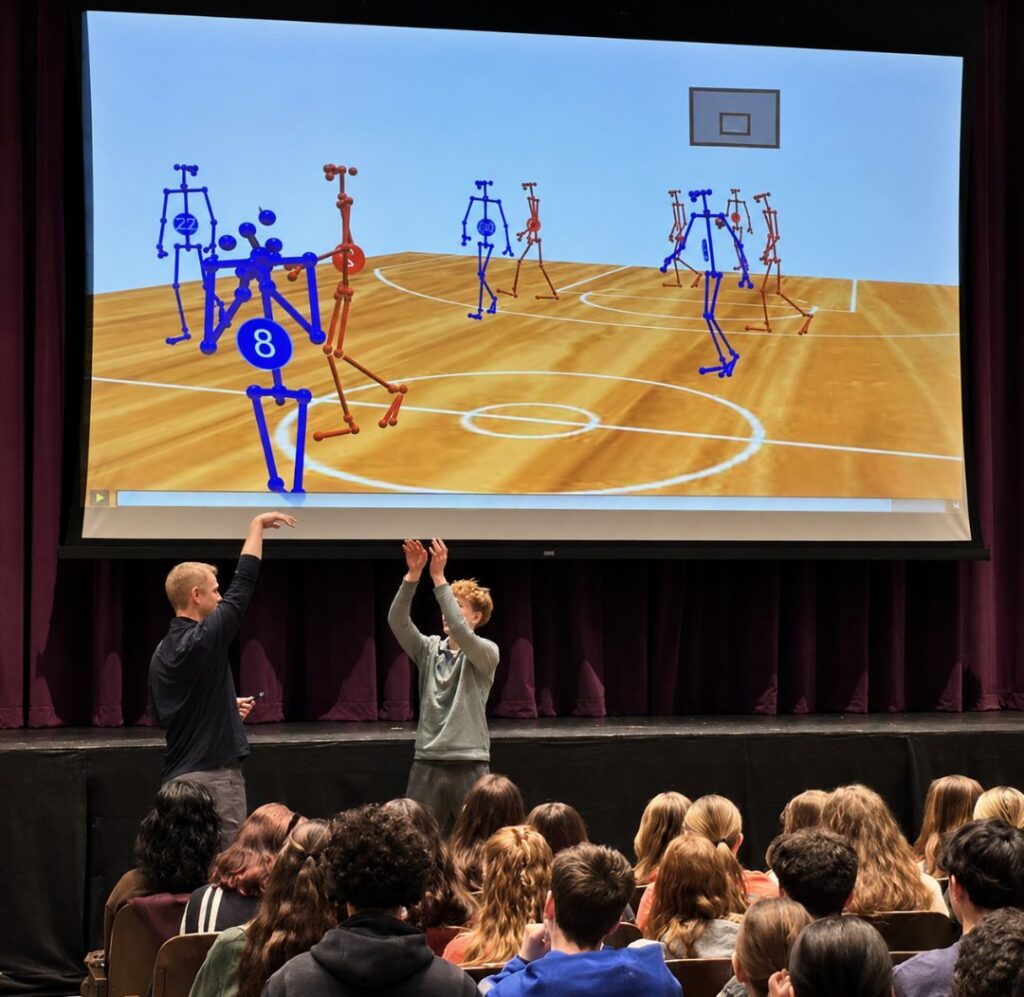
Rohlf demonstrates how the NBA’s player-tracking technology transforms X, Y and Z location data into advanced statistics, including the league’s Dunk Score feature.
The NBA’s Dunk Score – developed by Rohlf’s stats team – analyzes every dunk from every NBA game in real time by combining player tracking technology with NBA data science.
“Dunks are one of the most exciting plays in all sports, and we wanted to bring fans closer to that action,” Rohlf said.
During his visit to DGN, Rohlf explained to students how gathering X, Y, Z location data points generates a stream of information – including Dunk Scores.
Fans can view Dunk Score data on the NBA’s website and app to find out which dunks rise above the rest.